
Overview
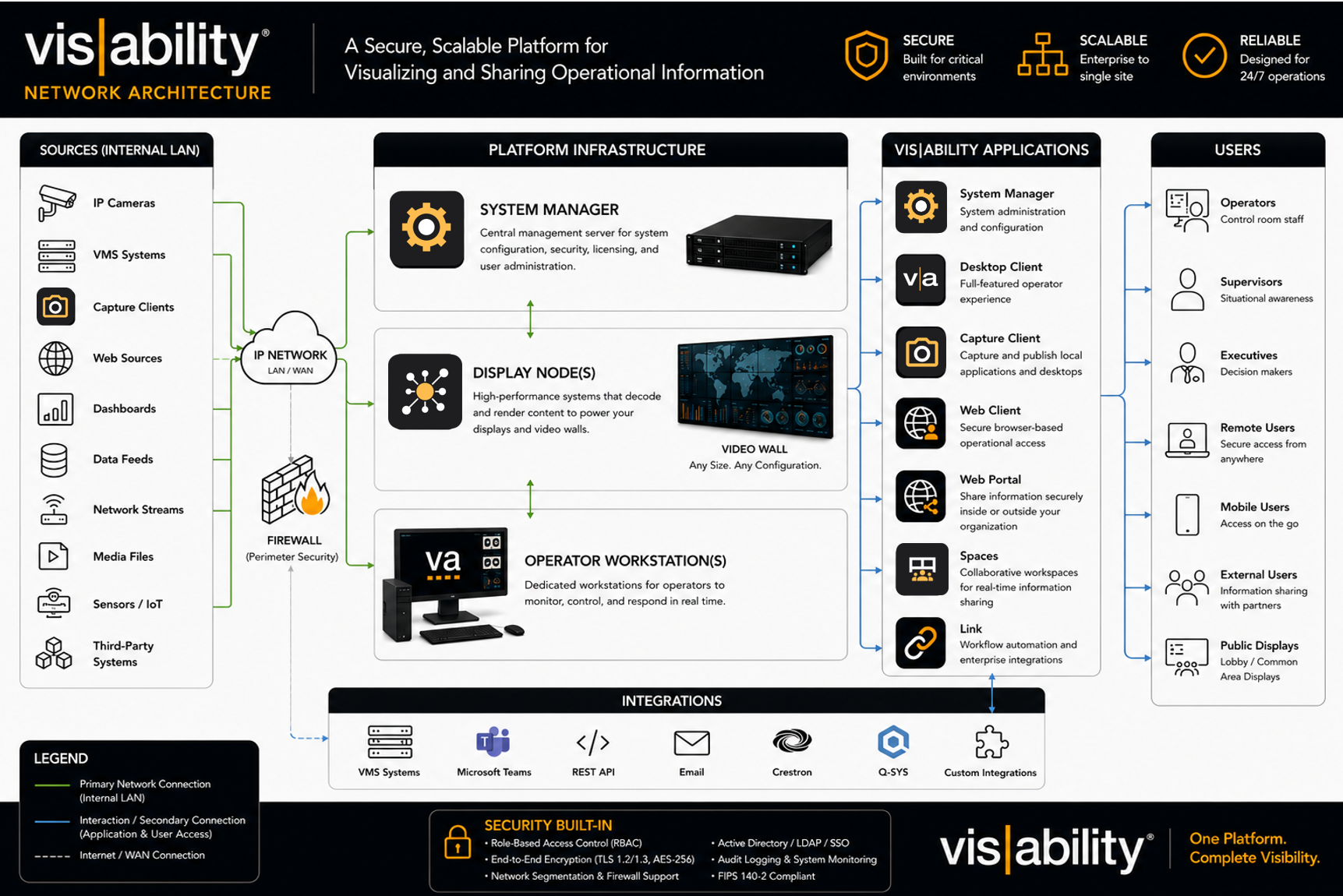
Unlike many enterprise visualization platforms, vis|ability is designed to operate almost entirely within your organization's existing network. There are no proprietary networking appliances, specialized protocols, or complex routing requirements. In most deployments, vis|ability functions as a collection of Windows applications and services communicating securely over standard TCP/IP.
Whether you're deploying a single control room or a multi-site enterprise environment, the networking requirements remain straightforward. Display Nodes, operator workstations, and the System Manager communicate across your LAN using configurable TCP ports, while external systems connect using industry-standard protocols and APIs.
For organizations with existing security policies, firewall segmentation, VLANs, or zero-trust architectures, vis|ability can typically be deployed without requiring significant changes to your network design.
Common Deployment Models
- Dedicated AV Network – Isolated network dedicated to audiovisual and visualization systems.
- Segmented VLAN – vis|ability components reside on one or more VLANs with controlled communication between network segments.
- Corporate Network – Components operate alongside other enterprise systems while adhering to existing security policies.
- Air-Gapped Network – Completely isolated deployments with no Internet connectivity, commonly used in critical infrastructure and secure government environments.
No matter the deployment model, the networking requirements remain the same: allow authorized communication between vis|ability components.
Preparing Your Network
Before commissioning begins, it is essential to confirm that both network and endpoint security controls allow vis|ability components to communicate as intended.
Firewall rules, network segmentation, and endpoint protection software are among the most common causes of deployment delays. Validating these settings in advance helps ensure commissioning proceeds smoothly and minimizes unnecessary troubleshooting.
The goal is simple:
You do not need to change your organization's security model—only ensure that required communication is permitted end-to-end.
This includes allowing communication:
- Across the network
- Between VLANs (where applicable)
- Through network firewalls
- At the operating system level
- Within endpoint protection and antivirus policies
Minimum Network Requirements
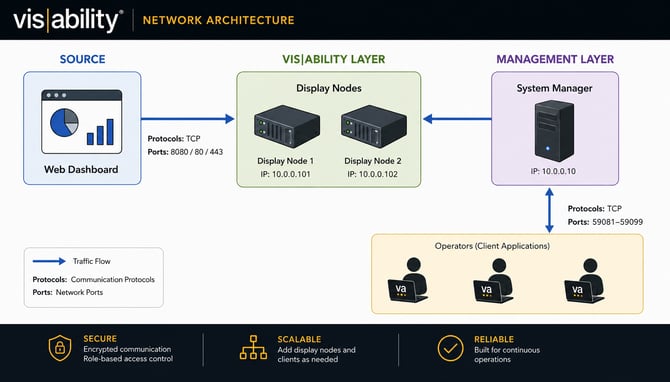
Network firewalls and routing policies must allow communication between all vis|ability components.
At a minimum, verify that:
- Required vis|ability service ports are open between applicable systems.
- Inter-VLAN communication is permitted where network segmentation exists.
- Routing is configured between all required network segments.
- Network security devices are not blocking communication between:
- System Manager and Display Nodes
- Display Nodes and Source Systems
- Client Applications and the System Manager
- Endpoint protection software does not block vis|ability services or executables.
If vis|ability components are deployed across multiple VLANs or network segments, routing and firewall policies should be configured and validated prior to commissioning.