
An Introduction to the Cloud
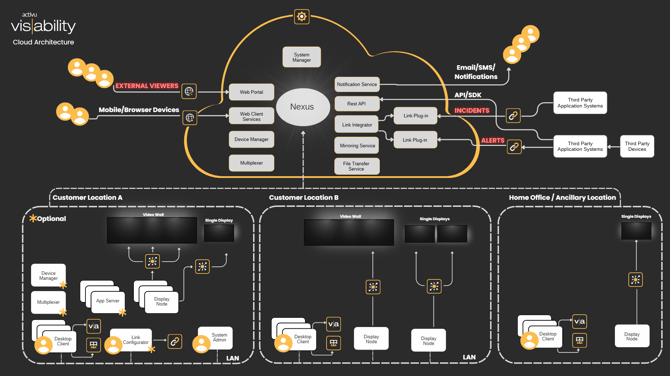
The Architecture
How the Cloud Operates
vis|ability Cloud is a cloud-based critical incident collaboration and visualization platform built specifically for environments that manage IT systems, security information, application performance, and operations (ITSM, SIEM, APM, ITOM).
It enables:
-
Fast access to information in context across distributed teams.
-
Seamless collaboration around live, critical data like dashboards, live streams, application windows, and documents.
-
Automated event-driven information sharing, connecting directly into business, process, and security systems (like ServiceNow, QRadar, Splunk) via Link plugins.
This means that critical alerts or incidents are detected by existing IT or security tools, processed through vis|ability Link, and automatically visualized and shared across command centers, remote users, video walls, and mobile devices without manual intervention.
Everything becomes accessible from anywhere: control rooms, remote desktops, ancillary sites, and mobile devices, creating a Virtual Command Center.
Architecture Overview
The vis|ability Cloud architecture is modular and layered:
-
Core Cloud Services:
-
Nexus: Central hub handling data, sessions, and synchronization between users and devices.
-
Mirroring Service: Synchronizes displays across multiple locations and devices.
-
Web Portal Service: Enables web-based access to shared spaces.
-
Device Manager: Manages remote devices like video walls, desktops, and displays.
-
Multiplexer: Efficiently distributes live streams (IP cameras, desktops) to users.
-
Notification Service: Pushes incidents, alerts, and SMS/email notifications.
-
API/SDK Integration: Connects with external systems for incidents and alerts.
-
-
Client-Side Components:
-
Desktop Clients: Users interact with live content, spaces, and controls.
-
Display Nodes: Hardware endpoints controlling video walls or single displays.
-
Mobile/Browsers: Lightweight external access.
-
-
Integration Layer:
-
Link Integrator and Link Plug-ins: Bridges vis|ability Cloud with 3rd-party platforms like ServiceNow, Splunk, Waze, and others.
-
Configurator: Allows users/admins to set up sources, users, permissions, etc.
-
-
Customer Locations:
-
Vis|ability can connect to multiple geographically dispersed locations (Location A, B, remote users).
-
Each location can have video walls, single displays, or desktop clients — all tied back into the cloud architecture seamlessly.
-
Business Value-Add for Control Room Customers
| Benefit | Description |
|---|---|
| Faster Incident Response | Automated, event-driven display of critical info shortens time-to-resolution. |
| Unified Collaboration | Connects in-room, remote, and mobile users into a single collaborative ecosystem. |
| Reduced Hardware Costs | Minimal on-site hardware needed — only thin Display Nodes and optional endpoints. Cloud backend replaces costly servers and matrix switchers. |
| Scalable and Flexible | Add users, sources, and locations instantly without major investments. Handles emergency surges (disaster response, cyber-attacks) smoothly. |
| Lower Operational Overhead | Less reliance on IT teams to configure or manage infrastructure — simple setup and use. |
| High Security and Availability | Built-in firewalls, virtual networks, and optional HSM (hardware security modules) ensure enterprise-grade protection. |
| Supports Hybrid Operations | Perfect for organizations needing hybrid control rooms (mix of on-premises and remote operations). |
| Value-Based Pricing | Predictable cost model: $95/user/month for users; $375/display/month for walls (plus optional plugin costs), making budgeting easier. |
vis|ability Cloud transforms traditional control room operations into a cloud-first, event-driven, collaborative environment, making critical incident response faster, smarter, and more accessible — whether on a video wall, desktop, or mobile device. Its architecture is modular, highly scalable, and integrates tightly with existing IT and security systems, delivering real business agility and resilience at a lower cost than traditional hardware-heavy solutions.