Overview
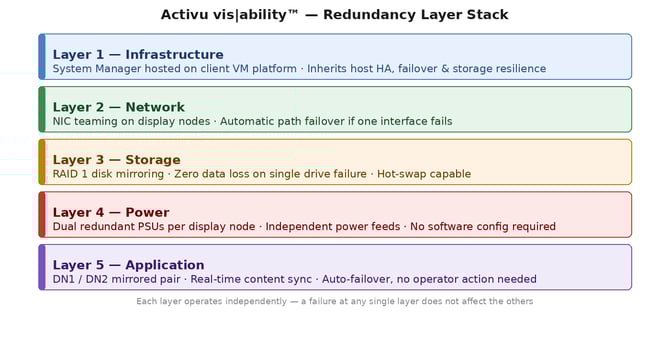
The Activu vis|ability™ platform is purpose-built for mission-critical command and control environments where continuous availability is non-negotiable. Redundancy is applied at every tier of the system — from infrastructure virtualisation through to application-level display failover — ensuring that no single point of failure can disrupt operations.
Infrastructure Redundancy
The Activu System Manager can be deployed as a virtual machine within the client's existing virtualisation platform. In this configuration, it inherits all native high availability capabilities of that environment, including automatic host failover, redundant shared storage, and data-centre-level power and network resilience. No additional Activu hardware is required to achieve infrastructure redundancy.
Network Redundancy
Each display node supports NIC teaming, which bonds two or more physical network interfaces into a single logical connection. If one interface — or its upstream switch port — becomes unavailable, traffic is automatically rerouted through the remaining active interface with no interruption to video wall operation. This eliminates the physical network as a single point of failure at the node level.
Storage Redundancy
Display node internal storage is configured as RAID 1 (disk mirroring), maintaining an identical live copy of data across two physical drives at all times. In the event of a single drive failure, the system continues operating from the remaining drive without any loss of data or disruption to display output. The failed drive can be replaced and the array rebuilt without taking the node offline.
Power Redundancy
Every display node is fitted with two independent power supply units. Each PSU can be connected to a separate power source, ensuring that the loss of either a PSU or an upstream power feed does not cause a node outage. This hardware-level power redundancy is transparent to the system and requires no software configuration.
Application Redundancy
At the application layer, two display nodes are configured to operate as a mirrored pair. The primary display node (DN1) drives all video wall sources and layouts. The secondary display node (DN2) continuously mirrors the same content in real time. Should DN1 become unavailable for any reason, DN2 automatically assumes full display responsibilities — maintaining visual continuity on the video wall without requiring any operator intervention.
Summary
Rather than relying on a single protection mechanism, the Activu vis|ability™ platform applies redundancy across five independent system layers. This defence-in-depth model ensures that infrastructure, network, storage, power, or application-level failures do not result in loss of operational visibility — keeping your command and control environment available at all times.